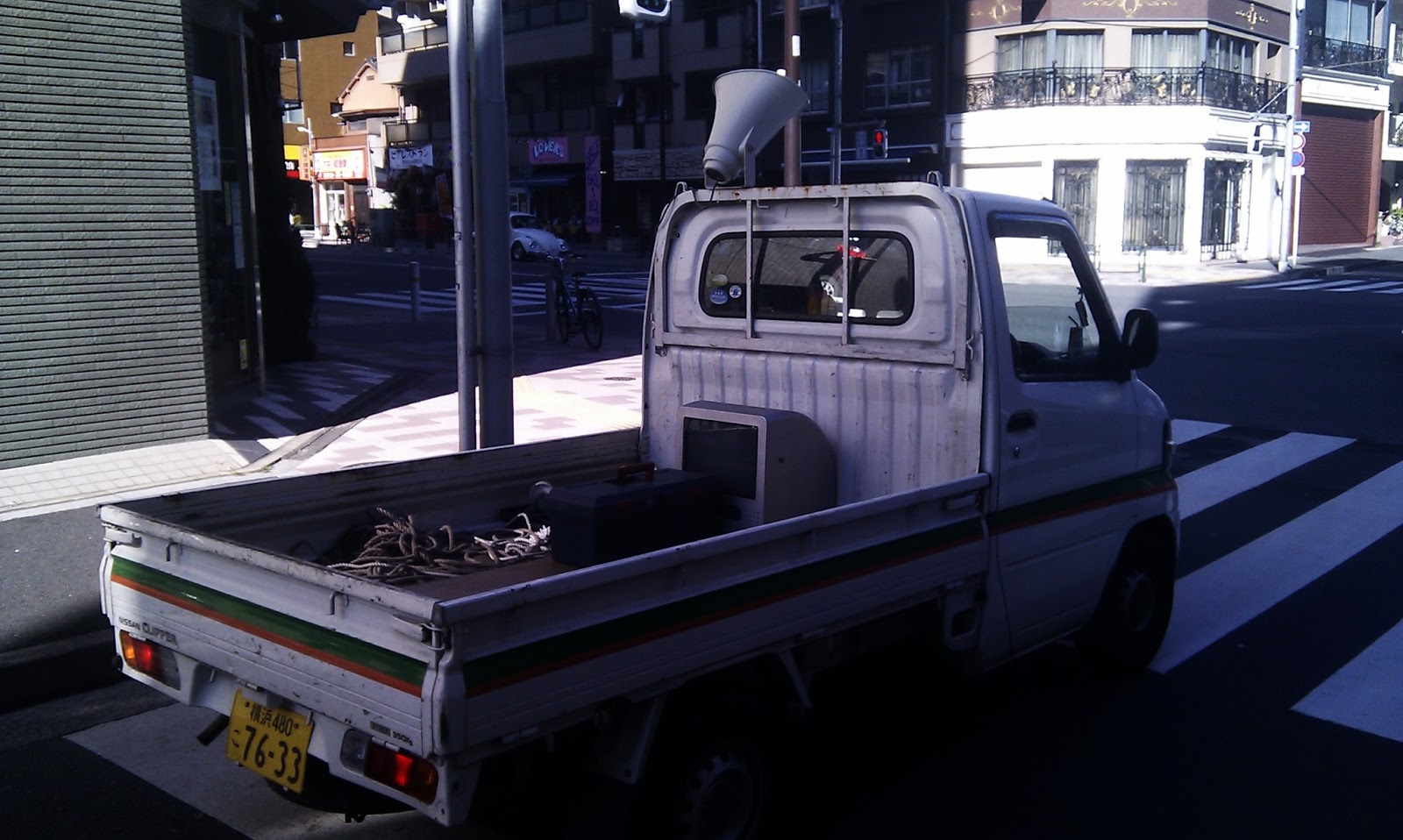
「ご家庭で不要になったパソコン・CDラジカセ・ステレオアンプ、などの家電製品を無料でお引取りいたします」
 |
| Recycle truck aka Gomi kaishusha |
Anyone who has ever spent any time in Japan has surely had the aggravating, gradual crescendo of this message over a kei-truck megaphone shake them from a perfect slumber on a lazy weekend morning. Gomi kaishusha, literally "trash collection cars" are ubiquitous to Japan, which is just one part of a larger industry of private trash collection and disposal.
I've personally used this service only once in over 13 years in Japan. I had the recycle truck guy take away an old computer monitor. When I first got here I didn't even know the "correct" way to throw oversized garbage away and with my not-so-finely-honed Japanese skills, I thought it was free so I tried it. That was when I learned it costs an arm and a leg to throw away appliances here. I think I was charged 1,500 yen even from the private trash collector guy. I grudgingly paid, since I didn't know any other way.
 |
| Ad for trash collection services |
I later heard rumors from Japanese friends that these private collectors just dump the garbage in nearby forests or the ocean. This seems to be the general consensus when you ask Japanese people about how these people can make money collecting what is basically garbage.
In the meantime this topic fell to the wayside. Trash disposal is not the sexiest topic and it rarely shows up in the media. An extensive article in SPA! shedding light on the issue of private trash collection caught my attention. The article was titled "The dark scrap created by home appliance recycling."*1
Well, well, well.
Dark scrap you say? My virtual ears perked right up.
First, some background. The current
Home Appliance Recycling Law was written in 1998 and
went into law in 2001. According
to METI this law was enacted because Japan had had previously been burying 60,000 tons of in the ground annually, which was either unsustainable or an environmental disaster, I'm not sure which. At any rate, it was time to find a new way to deal with it. The law will be expanded to include 96 electronics products including mobile phones and video games in
April 2013.
According to the SPA! report, there are far more people using the private trash collection services than the official government
sodai gomi pickup due to the lower cost. But how are these companies able to turn a profit by collecting garbage without burying it in the ground like the government used to do?
Many used appliances from Japan are shipped abroad. Just last September, a cargo ship bound for China that had just left Osaka with 1,000 tons of scrap (iron, non-ferrous material, plastic) from appliances
caught on fire and sank off Japan's Pacific coast near Osaka. It turns out the fire was caused by friction heat from lithium-ion batteries. China banned the import of whole, non-separated materials in 2010 and Japan also has so the appliances should have been processed before getting shipped.
 |
| The flow of used appliance scrap from Japan (taken from MOE) |
Shipping used appliance scrap abroad is a relatively large business in Japan, with
3.97 million items flowing out of the country in 2010 alone. The number of items exported is five times that of the used appliances processed as scrap domestically.
Apparently it is impossible for Japanese weekly mags to put out an entire article without some unnecessary mildly racist interlude, and this article was no different. The scrapyards in Japan run by foreigners are places where stolen goods can be sold or stored are "hotbeds of bad foreigner crime." At least SPA! qualified it with "bad."
Since 2011, with rapid economic growth in Asia, cheap appliances from China have become prevalent, and according to one private trash collector, has caused demand in China for exports from Japan to drop drastically. This in turn makes it unprofitable to dispose of appliances from Japan by exporting to China and other Asian countries. Meanwhile, e-waste from used computers and mobile devices is on the rise and China lacks metal resources so lead and iron can fetch a high price there. This creates a perfect scenario for shipping scrap.
If scrap exporters do not have permission from the
government, they have to go through regulated exporters to move their product out. If shipping containers filled with un-processed scrap are put through x-ray scanners or opened, it would be obvious that the shipper is breaking the law. However, scrap exporters skirt the law by forming Chinese/Japanese joint ventures that send a high volume so customs inspectors on both sides cannot check all the contents.
China has new laws prohibiting imports of non-separated scrap. Imports of used appliances are, by and large, illegal. However, according to SPA!'s source, there are many in the business of salvaging scrap metal from waste for resale and used appliances from Japan get into the country. Taxes imposed on scrap imports make the venture unprofitable so shippers must find illegal methods to move their unseparated scrap.
According to China journalist
Satoshi Tomisaka, the illegal operators have procured appliances from Japanese scrapyards in the past, but since 2007, seeking higher profit margins, they have taken over the scrapyards and even begun moving into the business of waste collection. There are a number of Chinese run scrapyards in Yotsukaido, Chiba and some of the drivers of the small trucks that get sent out to collect used appliances are actually Chinese. Sometimes these workers even pick up items properly placed on the curb as oversized garbage for the city to collect.
Much of the scrap appliances collected by illegal collection businesses are shipped to sorting facilities in
Zhejiang province in China where the valuable metals are stripped. Although there are toxic materials such as lead and nickel found in used appliances, this work is done by hand in China, even by children.
The
Chinese Youth Daily reported on December 13, 2011 that a large amount of illegally imported e-waste from the U.S. and Japan at a processing plant in Taizhou, Zhejiang had polluted the area and was becoming a social problem. This story has also been documented
elsewhere.
Another problem associated with used appliances and electronics is illegal dumping. This is a significant problem in Japan, with over
1.5 million appliances reported being dumped nationwide between 2000 and 2010. You can find warnings not to dump garbage in places like industrial areas, country roadsides and forests. According to the most recent
government statistics of illegal dumping of "big four" used appliances―TVs, air-conditioners, refrigerators, washing machines, Osaka and Tokyo are the worst offenders, followed by Chiba, Aichi and Hokkaido. Take a walk around the industrial bayside areas of Tokyo or look down into the murky waters of a local canal to see this phenomenon for yourself.
 |
Illegal dumping prohibited
You are being watched |
According to Meiji Gakuin University professor Kazuki Kumamoto, the practice of leaving garbage on private property and Japan's way of dealing with this perpetuates the problem of illegal dumping. The stance of local governments is to force property owners to deal with waste left on their land. Some places in Japan patrolled by local officials multiple times a day are still used as dumping grounds for home appliances and construction materials.
One worker at an industrial waste cleanup company tells SPA! that these illegal dumping grounds are almost always private land. The source explains that businesses are the ones disposing of construction materials but appliances are mostly thrown out by individuals out of convenience.
Haikyo, or abandoned properties are also generally private property so they are popular spots for illegal dumping. Even if there are complaints about garbage piling up at a
haikyo spot, local officials have their hands tied if it is private property.
 |
| A rare example of a non-private urban haikyo property |
With the rising demand abroad for scrap home appliances, there are even cases of scrap collectors "stealing" these items from illegal dumping spots. According to a Kanto area trash collector interviewed by SPA!, due to the declining number of appliances picked up by collection trucks, private trash collectors are increasingly turning to scavenging illegally dumped appliances. There is some irony that the demand for scrap has played a part in the cleanup of illegally disposed appliances.
 |
| It can't be helped |
"The Small Appliances Recycling Act in April 2013 will also cover small electronics that are not appliances," says Kumamoto. "This will only cause the number of types of illegally dumped appliances to increase. In Japan we should tack the recycling cost onto the price of the products as they do in the U.S. and Europe. As long as there is a cost attached to disposal of these items, illegal dumping won't go away."
So there you have it. If you get the recycle truck guy to take away your old electronics, be forewarned that it may be shipped to China and picked apart by children or might cause a fiery shipwreck. I know I will go the extra mile and pay the city to take mine. Waste not, want not.
1. 「家電リサイクルが生んだ闇のゴミ」 November 20, 2012 issue of SPA!