Showing posts with label Tokyo. Show all posts

2013/08/29

Great Kanto Earthquake Anniversary

Avid readers of this oft neglected blog may know that one of its writers resides in Tokyo and often runs through its many streets, alleys, parks and terraces. Anyone who has ever run in the 23-ku area will have been around the Imperial Palace at some point, but it's not likely that many know the lore around one of the trees there. It caught my eye to see a front page article on today's Sankei Shimbun about a tree in Otemachi. Then I remembered the 90th anniversary of the Great Kanto Earthquake is coming up this weekend. Below is my abridged translation of the story.


The Forgotten Disaster Tree

90 years since the Great Kanto Earthquake: Lessons and preparations


"The lone surviving tree in the burnt remains of central Tokyo that gave people hope."

On a corner of the street in front of the palace in Tokyo's Otemachi 1-chome, there stands a large ginko tree with lush green branches. Runners around the palace pass just near the tree, but few notice the signboard about the tree that survived the inferno that ravaged Japan's capital in 1923.

震災いちょう

There is still a black burn scar up the trunk of the tree that silently tells the story of the suffering from the disaster. According to the Chiyoda ward board of education, the tree is approximately 150 years old. Before the earthquake, it was located on the site of the old education ministry at Hitotsubashi 1-chome but was transferred to its current site as part of the reconstruction plan.

The burnt trunk

Like the lone "miracle pine" that survived the tsunami in 2011 in Iwate's Rikuzen-Takata, the ginko received much attention as a symbol of the imperial capital's reconstruction.

"I never noticed it. There are no other things in Tokyo that remind you of the 1923 quake," explains Kawasaki resident and once-a-week palace runner Kaori Kikuchi (38). For many, the happenings of 90 years past are now just distant memories.

The blaze caused many of the deaths in the Great Kanto Earthquake. Learning from the disaster, the national government created three large parks around Tokyo's shitamachi area―Sumida Koen, Kinshi Koen and Hamacho Koen―as part of the reconstruction effort.


Comparison of damage from past and future megaquakes 

However, the elevated metro expressway now runs above Sumida Koen, Japan's first riverside park. A public sports center was built at Hamacho Koen, changing the park's appearance from when it was built.

The Tokyo metropolitan government has designated both parks "evacuation areas from fires caused by earthquakes."

Ueno circa 1928

The parks were designed to allow one square meter for the estimated number of evacuees but a Tokyo official explained, "It is an unknown how well they will function in reality." It is undeniable that the parks are more about promoting public health and greening of the city, and the official admitted, "The top priority for Tokyo's parks has not been to protect against fires."

Hokkaido University graduate school professor Akira Koshizawa, an expert on the Imperial Reconstruction Plan had this to say about urban policy.

"The Tokyo metropolitan and ward governments that took over the parks from the national government did not fully understand the meaning of reconstruction, and redesigned the parks in their own ways. It's time we looked back on the Great Kanto Earthquake reconstruction to prepare for the next disaster."

September 1 marks the 90th anniversary of the Great Kanto Earthquake. As the memory fades, the next megaquake draws nearer. The Tohoku earthquake of 2011 was an important reminder for us to learn from the past. Are we prepared for the future?


2012/03/11

One year on

What is there to say at this point? The Great East Japan Earthquake of 2011 was probably the worst natural disaster the millions of us that decided to live on this (seismically unfortunate) island will experience in our lives.

There were several hundred thousand in prefectures of northeast Japan that had their lives changed forever. The primary victims lived in towns destroyed by tsunami, lived in close distance to the NPP or had homes destroyed or had friends or relatives that were swept away. Then there were the secondary victims, those that were out of power and basic services in the still cold end of winter months, had homes that were damaged or destroyed or businesses that went bankrupt due to inability to work or any other number of reasons. There were the residents of Urayasu that lost water and gas services for weeks after the quake. There were farmers in Tochigi, Ibaraki, Fukushima and more that could not sell their products. Finally, there were the rest of us. The majority of us on this island didn't succumb to any disaster. We all saw it on TV just like people all around the world.

Brix were shat


Those of us anywhere in the Tokyo area or west of it were VERY lucky. Other than the pain of seeing thousands of northwestern friends' and families' lives turned to living hell and the indirect effect from the meltdown, we got off virtually scot-free. Although there was a chance that the nuclear situation could have gotten even more out of control, it didn't, and our lives were not directly affected like the 330,000+ people in Tohoku forced to evacuate.

Personally I was safe in my office in Ginza for the main quake and the many shaky weeks that followed. There was a week or two when the whole world was freaking out about the nuclear situation. Many of us here southwest of the disaster zone were glued to our computer monitors madly taking in every iota of information we could about microsieverts, becquerels per liter, debating whether to stay or go. Everyone took it in, processed it, and made their own judgement about how dangerous it was. Some left for good. Some left temporarily. Some stayed. The amount of information and misinformation flying around the web those first weeks was incredible. How could anyone expected to be conclusive about what to do? It was first time for virtually all of us to experience a nuclear crisis first-hand.

Courtesy of jurvetson

Courtesy of fleep.com

Remember this gem? Turns out it was bullshit.


I ought to give a shout out to the voices of reason in the virtual onslaught of online "experts" that emerged after the crisis. They are the ones that put in hours to translate, report, blog and get out the word about what was actually going down. Some invaluable sources after the meltdown: @martyn_williams @timeouttokyo @hikosaemon @hirokotabuchi @W7VOA @1rick (notice they are all twitterers. Mainstream media was worthless when the shit hit the fan)

Well, that's pretty much how I feel about it, looking back. There are a million side stories (example) that have been discussed and wrangled over in the meantime. Many people choose to focus their anger on the people they see to be "responsible" for the disaster. There is no doubt that some (ahem, TEPCO board of directors, ahem, NISA and METI cough cough) could have acted with the needs of the country instead of the needs of shareholders in mind pre-3/11. Some people surely should be punished and an example set. That said, it may make you feel better, but pointing fingers doesn't end up helping the situation. There needs to be reconciliation. Forward-thinking people need to focus their talents to solve the deep problems that this country now faces (energy stability, food safety, bringing back tourists, how to pay for reconstruction, aging/dying countryside, etc.).

There is still a lot of work to do. I choose to believe that there are people that are resolute about fixing this mess. If there weren't, there would not have been people like Daiichi plant manager Masao Yoshida and the workers that stayed behind risking their asses when NOTHING was certain and local politicians like Shimada mayor Katsuro Sakurai (who was one of the few to accept debris from Tohoku for processing) putting their personal convictions ahead of their fickle, ignorant constituents. Fist bump to them and let's hope that they are not the minority.


PS. Watch this Frontline doc to see the razor's edge that the country was balanced on at the beginning of the nuclear mess.

PS2. 311 SUCKS!

2011/12/14

Tokyo human rights center Part 2: Dealing with burakumin discrimination in Tokyo

Continuing from our last post, let's consider discrimination that takes place specifically in Tokyo. Although much more toned down, it is an issue that resonates to this very day. Just jump on a 2chan aggregator or twitter and search for 同和問題 (dowa mondai, i.e., problem of discrimination based on real or perceived class difference) or 同和地区 (dowa chiku, i.e., areas where lower castes were once forced to live) to see the recent chatter.


The dowa chiku of Osaka (could not find a similar map for Tokyo)


I will try to make the translation as faithful to the original without embellishing in order to give an idea of what is being taught. I have added the original Japanese so you can check for yourself. Corrections are welcome. Let me know if you have any.


東京でおきている差別①
同和問題は、まだ解決していません。
私たちの住む東京でも、さまざまな差別が今も起きています。

◆差別的な落書き等
●公共施設や大学などで、同和地区出身者に対する差別的な落書きや張り紙が見つかっています。
●また、最近では、匿名性を悪用しインターネットの提示版に同和地区暴露や差別意識を助長するような無責任な書き込み も見つかっています。

◆連続大量差別はがき事件
●同和地区出身者の自宅などに、平成15年から翌16年にかけて、差別はがきなどが送られるという事件が発生しました。「えた、非人は人間ではないので人権はない」「死ね」「殺す」「住めないようにしてやる」というような誹謗・中傷・脅迫する内容の差別はがきが大量(全国で400通に及んだ)に送りつけられる事件でした。

犯行の手口も、
・被審者の自宅や近所に差別はがきなどを送りつける。
・被審者の名前をかたり物品を被審者宅に着払いで送る。
・被審者の名前をかたり、ハンセン病療養所に差別手紙を送りつける。
-など悪質なものでした。
「エタ、非人」の語は、江戸時代の身分制度が撤廃された後も、部落(同和地区)の人々を差別する言葉として使われ、当時者からは厳しい抗議がされてきました。この手紙でも「人間ではない」などと、きわめて差別的に使われました。
☆この事件の犯人は、平成16(2004)年10月に逮捕され、懲役2年の刑が確定しました。

このような行為は、被審者の名誉を傷つけ、生活を脅かし、精神的苦痛を与えるだけでなく、新たな差別を助長するもので、決して許されるものではありません。

Discrimination in Tokyo (1)
The dowa mondai is still not resolved to this day.
In Tokyo, many types of discrimination take place even today.

◆Discriminatory graffiti
●Graffiti and posters with discriminatory messages aimed at people from dowa chiku have been found in public facilities, universities and more.
●Irresponsible messages claiming to "disclose" dowa chiku and awareness of discrimination can also be found online, where these users abuse the anonymity of Internet forums.

◆Case of discrimination using postcards
●Discriminatory postcards were sent to homes of persons from the dowa chiku between 2003 and 2004. The postcards included slanderous, hurtful and threatening messages including "Eta and hinin are not human beings so you have no human rights," "Die!," "I'm going to kill you," "I will make it so you can't live there anymore."

How the criminal act was carried out:
・Postcards sent to the homes and neighborhoods of victims
・Items ordered under the victims' names and sent COD
・Discriminatory letters sent under the victims' names to Hansen's Disease (leprosy) treatment clinics
-and other vicious acts

The words eta and hinin were used to discriminate against people in the buraku (dowa chiku) areas even after the Edo era class system was abolished and people of the time severely objected to them. The letters included very discriminatory messages, such as "You are not human" and more.
☆The perpetrator of this crime was arrested in October 2004 and received a two year sentence.

This behavior is unforgivable because it not only disgraces victims, threatens their life and causes emotional pain, but also encourages new forms of discrimination.


東京でおきている差別②
◆就職にかかわる差別
企業等が従業員を採用するときには、本人の仕事への適性や能力のみで決められるべきです。同和地区の出身という理由で採用されないなどということは絶対に許されません。
しかし、実際には同和地区出身の人々に対する就職差別は起きています。
これまで、本籍地や家族の職業など、本人の仕事への適性や能力に関係ないことを履歴書に書かせたり、面接の際に聞いたりする事例がありました。

★6月は就職差別解消促進月間です。
就職は、生活の安定確保や労働を通じた社会参加など、幸せに生きていく上で基本となるものであり、採用選考は応募者本人の適性と能力に基づいて公正に行わなければなりません。
東京都では6月を「就職差別解消促進月間」とし、就職差別をなくし、就職の機会均等の確保を進めるため、東京労働局及び公共職業安定所と連携して様々な啓発活動を展開しています。

◆結婚に見られる差別
結婚は、結婚するふたりの意思によるものであり、憲法でもその権利と自由が保証されています。
平成11年に東京都が実施した世論調査では、子供の結婚相手が同和地区出身者と分かった場合、53.9%の人が「子どもの意志を尊重する」としているものの、約23%の人がなんらかのかたちで「反対する」「認めない」と答えています。
同和地区出身の人々に対する結婚にかかる差別意識は根強く残っています。


Discrimination in Tokyo (2)
◆Discrimination in the workplace
In selecting new hires, companies should base their decision solely on the individual's competence and abilities. It is totally unacceptable for a company not to hire someone due to the fact that they are from dowa chiku. 
Nevertheless, there are people from dowa chiku that experience discrimination in terms of employment.
There have been cases of companies asking potential hires to include on their resume location of their family registry (honseki), occupation of other family members and other information unrelated to job competence and abilities. People have also been subjected to this line of questioning at interviews.

★June has been designated "Month to eliminate employment discrimination."
Being able to seek employment is something fundamental to human happiness by allowing them to hold down a stable lifestyle and take part in society through work. When selecting potential hires, organizations must utilize a fair system based on competence and abilities.
June is designated "Month to Eliminate Employment Discrimination" in Tokyo and the Tokyo Labour Bureau partners with the Employment Security Bureau of MHLW (Hello Work) to implement educational activities that promote elimination of job discrimination and equal opportunity in the workplace.

◆Discrimination in marriage
The Japanese constitution ensures couples the right to freely enter into marriage based on their choice.
A 1999 survey conducted by the Tokyo metropolitan government found that 53.9% of parents would respect the wishes of their children if they decided to marry someone of dowa chiku origins. Meanwhile approximately 23% said they would oppose the marriage or not allow it.
Discrimination against people of dowa chiku origins in the case of marriage is deeply-rooted.

For more about buraku discrimination, see the Headquarters of Buraku Liberation League or this great buraku resource in the Harvard Human Rights Journal.

In our next post, we will talk about foreigners in Japan and the Ainu.

2011/10/15

Tokyo human rights center Part 1: History of Discrimination in Japan

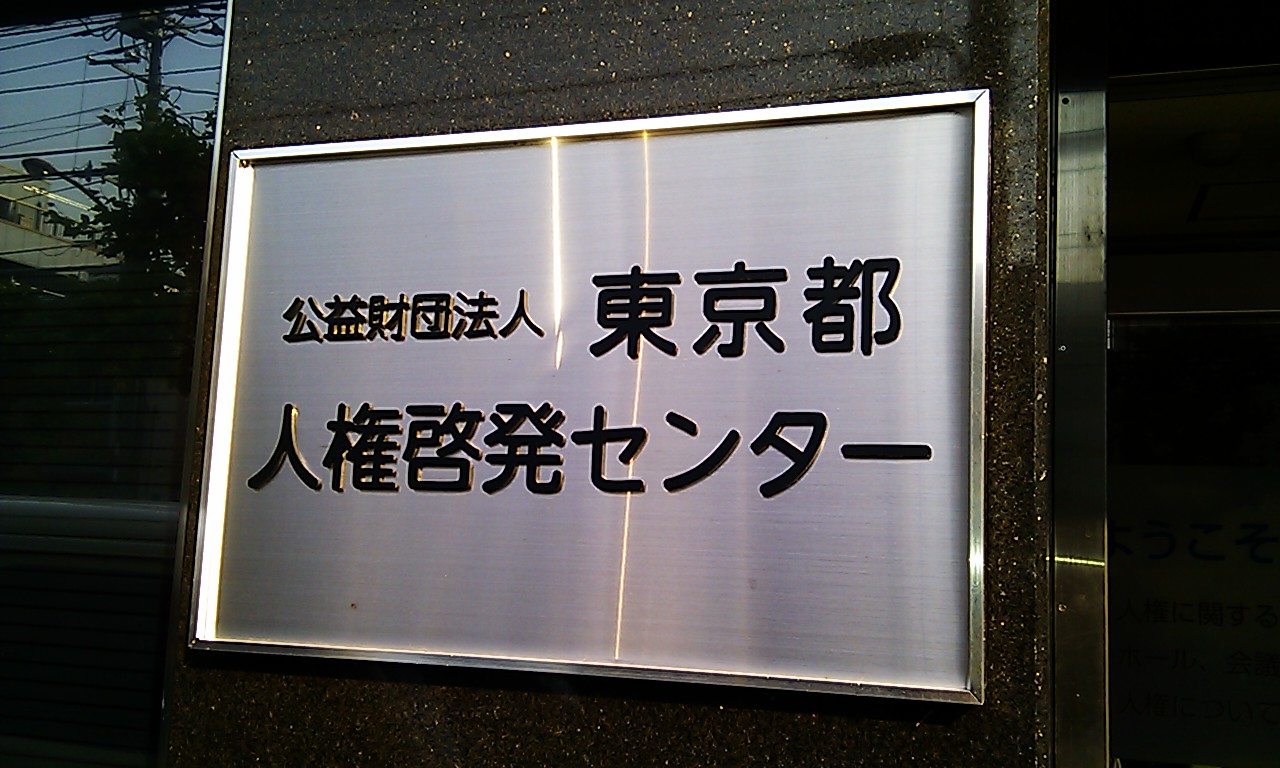
So, I was on my way home from a run in the grey hinter-regions between Minami-Senju and Kita-Senju and this uninspiring, drab public building had its doors open.


Yes, you read that correctly. It is the human rights learning center for Tokyo.


"Human rights?" you might be asking. Well, let's venture inside.


The first thing one is confronted with upon entering is a history of human rights in Japan over the years. (this oughtta be good...)

革づくりの歴史 1
History of Leather Making part 1 (hmmm. Interesting. Where might they be going with this?)

1991年、アルプス・チロル地方の氷河のなかから、世界で一番古い革製品を身につけた約5000年前の凍結ミイラが発見されました。牛革製の帽子、火打ち石の入った皮袋、毛皮の服です。これらの製品は樹皮などの植物でなめされていたと推定されています。
日本でも古くから皮革が用いれられており、日本の革づくりの歴史を紹介いたします。

・古代から中世
皮革は古代から武具や献上品として用いられ、6~7世紀には朝鮮半島から渡ってきた人々によって革づくりの技術が向上しました。平安時代後期からは、皮革業は次第に手工業として広がりました。これを担ったのが「河原者」「キヨメ」と呼ばれた人々です。

・戦国時代
戦国時代の武将は革づくりを重視し、武具製造に必要な皮革技術者を集め支配下に置きました。皮役を命じ、その代償として皮革等の専売権を認めました。
この時代にも、皮革技術者に大して「ケガレ」観などによる見方はありましたが、差別は固定化していませんでした。

In 1991, a 5,000 year old frozen mummy was discovered in the Tyrol area of the Alps. It was clothed in the oldest leather items ever found, including a hat made from cattle hide, a leather pouch for holding flint and clothes made from animal skins. These items are assumed to have been tanned using bark and other plants.
Like Europe, leather has also been used in Japan since long ago. Here is a history of leather making in Japan.

・From early history to medieval times
Leather has been used since ancient times for armor and offerings. Improvements in leather technology were made thanks to the arrival of peoples from the Korean peninsula in the 6th and 7th century. In the latter Heian era (794-1192?), leather-working gradually spread as a handicraft industry. Those that took up this trade were referred to as Kawaramono or Kiyome.

・Warring States period (mid 15th to early 17th century)
In this period, making leather for the commander was first priority and those capable were assembled and subjugated to making armor. They were designated as leather workers and as given exclusive rights to sell leather as compensation.
In this era, the leather workers were looked upon as being unclean but the discrimination had not yet been institutionalized.


Okay. Next, let's move on to the Edo period (1603-1868).


革づくりの歴史 2
History of Leather Making part 2

江戸時代
豊臣秀吉は太閤検地・刀狩などによて、武士と農民を分離していきました。その後の徳川幕府はさらに政策を進め、その過程で歴史的、社会的な経緯で差別されていた人々を次第に身分として固定し、さまざまな人々をそこに組み込みました。
皮の生産を専業とされた人々は農民や町人とは別に扱われ、服装や交際など生活全般の制限、村の行政からの排除など、周囲の民衆からもさまざまな差別を受けるようになりました。
禅左衛門は関東地方を中心とする被差別民の「頭」で、幕府は禅左衛門に革づくりや灯心の製造・販売の権利、多くの芸能の監督権などを与える一方、被差別民を刑吏や町奉行の下役などに従事させていました。
関東では、解体処理した牛馬の皮は禅左衛門のもとに送る決まりになっていました。原皮は塩漬けなどで浅草に運ばれ、禅左衛門とその配下の人々によってなめされたのです。

Edo period
With Hideyoshi Toyotomi's nationwide land survey of 1582 and the "sword hunt" of 1588, the warrior class and the peasantry were separated. The Tokugawa shogunate further extended this policy later, causing discrimination against a variety of people to become entrenched due to historic and social reasons.
Those in the leather-making profession were treated differently from other peasants and townspeople, with wide-ranging limitations placed on what they could wear and who they could associate with. They were excluded from local government and were discriminated against by the population at large.
Danzaemon was the person in charge of the outcasts of the Kanto region. Although Danzaemon was given the rights to produce and sell leather and candle wicks as well as the right to oversee many of the performing arts, he was also tasked with execution of outcasts and served as an underling to the town magistrate.
In the Kanto region, it was necessary to send skins of slaughtered horses and cattle to Danzaemon. The skins were brought to Asakusa for salting (part of the tanning process) then tanned by Danzaemon and his subordinates.


近代皮革業の起こり
The origins of modern leather making

・近代皮革業の系譜
明治維新とともに、欧米のなめし技術の移入により皮革業の近代化が進められ、また、近代的軍隊に必要な軍装品の製造が始められました。
皮革産業の近代化には次の3つの系譜があり、現在につながっています。
1.在来の皮革技術をもとにしたもの(弾直樹など)
2.政府と取引のある商人が始めたもの(西村勝三など)
 ー西村勝三が創業した3月15日は「靴の日」となっているー
3.禄を失った土族などに職を与えるためのもの(大塚岩次郎など)

・弾直樹の皮革・靴工場
弾直樹は、被差別民の生計を確保することも目指しました。このため、欧米の皮革技術を習わせ、靴などの製品を軍隊に納めることを計画し、明治3(1870)年には兵部省の契約を得て、翌年王子滝野川(北区)に「皮革製造伝習所」を開設しました。
 アメリカから技師を招き、それまでの革づくりの伝統をもとに、近代的な皮革の製造や靴づくりを目指しました。

明治4(1871)年、被差別民の皮革専業権が廃止され、原皮の入手が困難になっていきました。
明治5(1872)年には、工場を浅草に移転しました。
弾は、経営的には成功したとはいえませんが、多くの被差別民に新技術を伝え、育った技術者は、その後のわが国の皮革産業等や靴製造業を担っていったといわれています。
 

The origins of the modern leather industry
With the Meiji Restoration, European leather tanning techniques were adopted in Japan, which helped modernize the leather industry. It also facilitated the production of military equipment for a modern military.
The modernization of the leather industry can be traced from three important routes, which extend to the modern day:
1. Traditional leather making techniques (Dan Naoki, etc.)
2. Business between the government and merchants (Nishimura Katsuzo, etc.)
 (March 15, the date Nishimura opened the first shoe factory in Japan is celebrated as Shoes Day in Japan today)
3. To provide employment to the Monguor people and others that lost their salary (Otsuka Iwajiro--the man who founded Otsuka Shoten, which is now Otsuka Shoe Co., Ltd. etc.)

・Dan Naoki's leather and shoe factory
Dan Naoki (the 13th and final Danzaemon) had the goal of securing a livelihood for the outcasts. In order to do so, he was ordered to learn European leather technology, and made plans to supply shoes and more to the military. In 1870 he was rewarded with a contract with the Ministry of War and in 1871 set up a leather production learning center in the Takinogawa area of Oji (present-day Kita-ku).
 American specialists were also brought to Japan to help modernize leather production and shoemaking based on traditional methods.

In 1871, with the abolition of the outcast system (exclusive trade in leather), animal skins became difficult to obtain.
In 1872, the factory was moved to Asakusa.
Dan Naoki was not exactly successful managing the factory, but he helped explain the new technology to many outcasts. These new specialists that he trained shouldered the burden of leather and shoemaking in Japan from this point.


So, there you have it. It's not the most detailed or informative explanation, but this is the effort the government of Tokyo gives to educating citizens about its several-hundred year long untouchable system.

For more about Japan's outcast system I recommend checking out Japan's Invisible Race by George A. De Vos. (1966)


View Larger Map

Stay tuned for Part 2 for some information about Ainu history and fun facts about gaijin in Tokyo.


(Note: All explanations here are translations.)

2011/03/14

Living in the Twilight Zone pt.I

The past several days have felt like living in a Rod Serling narrated otherworld. To recap my personal experience since 2:46 p.m. on Friday March 11, 2011 would require writing a short novel. I will spare you that, but want to leave a comprehensive record of what I experienced this week.


Friday, March 11th

It was a normal Friday afternoon. Slightly busier than normal at the office, I took the unusual step of writing a list of all the things to do that day before I left that day. It was six items long. I had only crossed off one translation job that I had finished in the early afternoon by the time two came along. A brainstorming session about how to encourage foreign tourists to come to Tokyo was scheduled from two o'clock. The meeting--about eight or nine strong--included several
Japanese co-workers and the one other American guy. There were some zany ideas being thrown around by the locals, including promotion of "power spots" (?) and chambara classes. There was some eye-rolling taking place among myself and guess who amidst the wild conjecture by the Japanese team about where Europeans would love to spend their lovely imaginary future trips to Tokyo. All in all, a typical, patience-grating waste of time.

At some point I notice the room wobbling slightly. I quietly observed,「揺れてる・・・」(it's shaking), at which point the brainstorming died away and all eight of us sat there in relative silence waiting for the shaking to calm down. (We had just had a relatively long, but mild earthquake about a week before that lasted about a minute. I thought was a little out of the ordinary for the type of swaying--it was very slow and rocked like a boat rocking on 2-D waves. Like being in a raft in TRON. )

The odd thing about this latest quake was it just kept going and going, albeit slowly. Then, at the point when most earthquakes start to die down, it very gradually began to grow stronger and stronger and started really feeling like a boat in a storm. At some point, when the table started moving around, the girl next to me began to lose it, asking around if we should actually protect ourselves (this is VERY uncommon in Japan, where most people don't bat an eyelash at a semi-powerful earthquake, yet constantly moan about the temperature being 1 degree below their comfort zone). I think we were all getting concerned by this point. Normally people here would never consider actually running outside (we were on the sixth floor so the amount of time required to get out would likely mean the quake would be over before you get out).

I remember hearing some crashing sounds in the background. This was our final signal to bolt. I couldn't tell if they were buildings collapsing outside or ...? (I later found out it was the bookshelves and PC monitors falling over in the next room.) People started heading toward the door and we scuttled towards the never used emergency fire escape stairwell.

From what I remember it was still shaking by the time we got all the way downstairs and outside. It really felt like it was not going to stop.

Some videos that show the power of the quake:


The entire company (200+) was safely evacuated to the nearby park to stand around freezing and sharing spotty information that was coming through twitter and TV (one-seg). About two hours later after everyone was accounted for (and a few more large aftershocks), we were instructed to head back to the office in an orderly fashion. People on the 9th floor first, followed by the 8th floor and so on.

The evacuation in the park:


We got back to the office to clean up the fallen bookshelves and computers. One bookshelf that had been crammed with magazines was a huge mess and someone turned to me to say, "見なかったことにしよう" (Let's pretend we didn't see that). I nod and move to my workspace. After a lull of what must have been 30 seconds, another uncomfortably large aftershock kicks in and that's when we realize it's time to haul ass out of there for good. No more work will be getting done even if the aftershocks were to stop.

Once back out on the street, there is some awkward mulling about to figure out who is walking in which direction, as the general consensus is that work is done. One guy starts getting vocal, questioning why we can't stay and work. It is too early to go back, he pontificates--"I haven't even been able to get through to the client yet!" Either dazed or annoyed, (in my case) no one argues, and at this point, several groups that thought they could get a taxi together went off to try and do so. I found some people walking towards Ueno and started back toward my house.

It's about an hour long walk that turns to a trudge, with growing numbers of people marching in one direction or another. As we get closer to Tokyo station and Nihombashi the human herd becomes thick.

The only damaged building I saw on the way home:


The view of my room when I finally got home:


Although it seemed bad at the time, based on all the tweets and facebook posts I was reading on the way home, I imagined that the damage here in Tokyo was nothing compared to what it must be in Miyagi prefecture...

(to be continued)

2011/03/12

The Big One Finally Hit

It finally happened. The big one hit. Somewhere around magnitude 8.8 (Update: final magnitude calculations concluded at magnitude 9) at the epicenter up in Miyagi prefecture several hundred kilometers north of the metropolis. Here in Tokyo the magnitude was a weaker, but nevertheless a serious earthquake. Apparently, it was the strongest earthquake in Japan's recent recorded history, and the fifth largest earthquake globally in recent history. To what extent these figure are exact or accurate, I do not know.

As I write this at around 11:00 pm, Friday March 11th, 2011, we are still experiencing aftershocks in frequent intervals (Update: According to a Nikkei headline we will be experiencing aftershocks well over a month. Additionally, I have heard talk from people in the Chuuestsu region saying that they experienced aftershocks for up to a year after their fatal quake in 2004). I'm also a bit shaken up (no pun intended) from the events that transpired today.

Tokyo has literally grinded to a halt. All JR train lines have suspended operations. Highway are at a standstill. Buses are being crammed with people trying to at least begin to head in the general directions of their homes. Several subway lines have resumed operations, but the situation will be dire at best, as masses of people will attempt to squeeze their way in making the usual rush hour commute seem like a luxury limo ride with champagne service and stripper HJs.

I'm not really able to focus too well while watching the devastation in northern Japan unfold on TV and the Internet, so this entry, which happens to be the first one in a long while (as well as the first of 2011 for Anaba: Happy New Years?), may not be as well written as I desire. However, I want to share my experience today, as insignificant as it may be in the grand scheme of today's disaster.

Around 2:45 pm this afternoon I was fumbling through some code at my day job when the earthquake struck. Now, at first it just seemed to be a regular quake. We had a decent one earlier this week that lasted a minute, but all in all it wasn't really shit to raise any alarm. Anyway, about a minute of gentle swaying suddenly gets exponentially stronger. My 30 to 40 year old 4 story office building starts to bounce amidst the swaying. The blinds start smacking against the window sills, hard. Monitors start toppling, and we hold onto whatever electronics we can grab while halfway begin to duck for cover under the big work table.

It felt like an eternity. It was probably about 3 minutes, realistically, maybe less. Magnitude. Mother. Fucking. 8.8. (M9 now, breh). All of us in the office quickly gathered all of our stuff, put the monitors and desktop PCs flat on the ground, as well as some other items that would be prone to toppling in the aftershocks, and leave after the initial quake.

As soon as we made it out of the building we were greeted by a massive crowd of evacuees in the neighboring offices. After a few minutes of chatting with the neighbors, we decided today's work was pretty much done and dispersed to are respective destinations.

From my office in the Hanzomon/Kojimachi area by the Imperial Palace I started to walk home to Koenji via Shinjuku-dori. Right when I reached Yotsuya station the first aftershock hit. I noticed how intense it was when I started to walk across the bridge crossing the tracks and the bridge started shaking. I decided to back track a few steps to avoid a potential collapse and turned around to witness the surrounding building swaying about gently like grass in a windy field.

Immediately following the aftershock I proceeded across the bridge to a major intersection. As I was constantly looking around, 360 degrees, to make sure debris wouldn't come crashing on my head, I noticed plumes of black smoke off in the distance toward what I think was Shibuya.

I continued on Shinjuku-dori toward Shinjuku and noticed in the sky jumbo jets and other passenger jets flying over the skyscraper district; a rare site as most of the city is a no-fly zone. However, the current circumstances had pretty much rendered the airports inactive. Flights were being looped and diverted.

The rest of the way home was surreal. The streets were packed with people heading somewhere, most likely home or a friend's place. Zombies wandering aimlessly came to mind.

It was a brisk day with strong gusts of wind every so often, and a bit of a piddling rain for about 20 minutes at one point.

The streets were jammed with cars going nowhere. Apparently, it was nearly impossible to hail a cab, and the line up for buses went on for blocks.

The noises of the city were dominated by sirens blaring everywhere; cops, firefighters, gas-works response teams, and ambulances. The hubbub of worried citizens layered by the sound of radios, TVs and 1segs broadcasting emergency reports were filtered by the gusts on wind. Once I got near the tracks of the Chuo-line it became eerily silent. I'll say it again: Surreal.

When I finally made it home I wasn't surprised to find some of my electronics on the ground. I haven't even got around to checking to see if they were broken or not. At least I know now  for sure that my desktop is in order, as I spent the following several hours watching and reading reports online, contacting people via Facebook and Twitter, and shitting the proverbial brick about whether my good friend and TokyoAnaba contributor, globalimagination, who lives up in Fukushima (a.k.a. Tsunami country), wasn't engulfed in the brutal Pacific tide. He's okay by the way.

At one point my friend David who lives nearby stopped by and we set off to grab a few supplies. On the way back we saw some debris that had fallen off a Showa-era edifice. Check the photos below.

I'm exhausted, so I apologize if this post is written poorly, if there are errors, blah blah blah. Tired and ready to sleep, as long as the aftershocks don't keep me up all night. Burn the midnight oil, I suppose. Doing what, who knows?

The TV was originally on the floor, but the it was propping the doors against the wall, originally. The force of the earthquake had moved the doors and TV out about 2 feet.

A couple of my laptops, drum machine and midi controller along with some other  detritus littered about in my study cum bed (futon) room.

Fallen debris from an old building in Koenji.


Where the debris had been pre-quake.

2010/12/12

The Ongoing Humanification of Akihabara: 2k540 AKI-OTA Artisan

So, I was pedaling through Akiba (as I do pretty regularly) and noticed something odd. A warm glow was emanating from the black hole that had been the empty space below the Yamanote-sen tracks.

The space had been empty for a few years. Lately there has perpetually been a homeless guy taking up residence in front of the deserted space on the sidewalk. The location (an underpass about halfway between Akiba and Okachimachi, hence the Aki-Oka name) at Kuramaebashi-dori was previously home to a huge Hanamasa Carne Station yakiniku buffet restaurant, which still lives on in Ginza and Asakusa. The Akiba one closed sometime in 2005 or so (the comments on the gurume sites seem to stop in 2005; I last went in 2003 or so).

2010/12/04

Tokyo Roofscapes (Pt. I)


Iwamotocho


Hachobori


Higashi Ueno 4-chome


Yanagibashi 1-chome


Asakusabashi 1-chome


2010/11/07

Vegetarian Dining in Tokyo - Eat More Greens Azabu


Situated a street behind Azabu Juban dori and a few blocks from the station, this stylish corner cafe-restaurant has a good selection of vegetarian and vegan sides and main dishes including Vegan Mabo Nabe and Black Rice, Falafel and Black Bean Vegetarian Taco-rice.

The atmosphere was decent, with an open air patio and no smoking inside. A few gwai-lo on hand, but this is to be expected. They weren't the majority at least, and the Engrish on the wall and menu reinforced the fact that this was a uniquely Japanese vegetarian experience. Another pleasant surprise was the hip-hop they had bumping, which was of that rare chill, boom boom bap 90s vintage that added the unexpected dimension of me wanting to stick around even after finishing.

2010/07/23

Top 10 Reasons Why Taito-ku is TOO Convenient


1) Public restrooms on every other street corner (as if all the alleys and crevaces weren't enough places to piss and puke)

2) Delivery alcohol (kakuyasu) -- Just another reason to get faded

3) Throw a stone, hit a train -- I have a theory that the overabundance of public commuting options keeps a lot of the residents from ever learning the rules of the road, so they end up being horrible pedestrians, bikers and drivers

4) More Chinese restaurants than China -- Discourages residents from ever going anywhere, making them insular

5) Akiba -- (Technically the main part is Chiyoda but the Akihabara address is Taito Ward) Where else can you find a universe of computer parts, animated porn, hi-end audio equipment, asian maids, kebabs and nerds in one place? Oh so convenient, yet oh so wrong.


Watch for reasons 6-10 in our next installment...

2010/02/08

Keepin' it Kechi


The zokugo dictionary defines kechi as:

1. Avoiding the use of money and goods 
2. Being poor, trifling, and foolish
3. Fussy, plebeian, narrow-minded
4. A bad omen; unlucky


I've been called a lot of things in my life, but one that I never considered a putdown in Japan is kechi, or "cheapskate." People tend to use the word with vitriol but I look at it like this: hunting for bargains is all about finding value. If you're not a doctor, lawyer, SAP consultant or some other douchebag richer than me and you have a lot of interests (beer, etc.), you have to make the most with a small purse. It takes skill and imagination to make the most of your time in a place like Tokyo. Truth is, I've been consistently bordering on broke all my adult life. Can you be a cheapskate and broke at the same time?

I work in Ginza and live in Asakusa and consider myself the east-side Tokyo connoisseur, so I'll be reporting mostly on this side of town. My philosophy has always been the cheaper the better, so let me kick things off by introducing some of the rare wan-coin (500 yen or less) lunch options in one of the most expensive areas in the most expensive city in the world.


Chuo Ward City Hall (中央区役所) 11th floor employee cafeteria


Although it's an employee cafeteria, anyone can get into this one. Menu varies but regulars include ramen (400-500 yen), curry rice (350 yen), tonkatsu (600 yen) and some other teishoku sets (550-650 yen). Enjoy a panoramic view of Tokyo bay and Odaiba and a huge selection of vending machine drinks in this oasis of fashion (be prepared to be surrounded by oyaji bureaucrats). Whatever you do, avoid the fried rice. Unless you like the taste of cat food.


View Larger Map


東京都中央区築地一丁目1番1号